Years ago I was introduced to this book by a colleague with a much larger brain than mine. At the time I was doing a lot of technical presentations and longed to breakaway from the "art in the dark" PowerPoint culture and find better ways to effectively display data.
I was fascinated to the point of frequenting Edward Tufte's web site, purchasing other Edward Tufte books and actually attending one of his day long seminars with my team.
This journey towards better data visualization has led me to become a big fan of Craig Robinson and his awe inspiring baseball site called FLIP FLOP FLY BALL. He hooked me in August of 2010 with his roster display of the 1972-74 Oakland Athletics dynasty and I have been an Flip Flop addict ever since. Here is a handy link to all FFFB's tagged infographics, prepare to spend a couple of hours savoring these. Although not heavy with data, the lesson on ball cap sticker removal is an absolute classic. Also, his own personal log of headwear should resonate with hat lovers every where.
If you are mildly interested in this stuff... I strongly suggest you follow Craig on Twitter and Tumblr.
Where is all this going? This weekend I couldn't stand watching the Phillies continue to fall into the abyss and I changed the channel to watch the Orioles instead. I got to enjoy Jim Thome smashing his first two dingers in a Baltimore uniform. These were career home runs #610 and #611 for Big Jim. I was inspired to sit down and take a shot at my own "visualization" of Thome's career:
I had forgotten that Thome did not homer during his 17 game pinch hitting stint with the 2009 LA Dodgers. In the event that blogger re-sizes the original image, here is a link to inteneded 1680x1050 resolution. I just hope I have left enough room for more "Orioles Orange" dingers at the bottom.
Showing posts with label Indians. Show all posts
Thursday, July 26, 2012
Tuesday, July 3, 2012
1974 All Star Project: AL Bench
Continuing on with this project... here are the non-starting position players from the 1974 American League All Star Squad.
| Sal Bando. As you expect from a dynasty, the Oakland A's are well represented on the AL squad. Bando was the captain of the three time world champions. 1974 would be the final of his 4 career All Star selections. He was injured and did not play in the game. | |
| Dave Chalk. A former first round draft pick, 1974 was Dave Chalk's first full season in the majors. Looking at his stats, I have no idea how or why he made the AL All Star roster in both 1974 & 1975. In 1976 he became the last major leaguer to play a full season (at least 500 PA) and hit 0 home runs and steal 0 bases. He played third in the bottom of the eight and struck out in the top of ninth inning. | |
| Bobby Grich. This was Bobby's second of six total All Star game appearances. He also won four gold gloves at second of the Orioles. He replaced Rod Carew in the bottom of the third and delivered one of the four AL hits. | |
| George Hendrick. A member of Dick William's 1972 World Champion Oakland A's... Hendrick was appearing in his first of four career All Star games. He replaced Bobby Murcer in centerfield in the bottom of the fifth inning and singled to lead off the sixth inning. | |
| Ed Herrmann. 1974 was the only All Star game Ed Herrmann was ever selected for. He did not play. | |
| Al Kaline. Appearing in the final of his 18 career All Star games, Kaline would collect his 3000th hit and retire from the big leagues at the end of the season. He pinch hit for Gaylord Perry in the top of the fourth inning and fouled out to the catcher. | |
| John Mayberry. A member of both the 1973 and 1974 AL All Star teams. In 1973 he led the American League in on-base-percentage. He grounded out to first base as a pinch hitter. | |
| Don Money. This was the first midsummer classic appearance for Money. He would make the game three more times in the 1970s, starting at second base in the 1978 game in San Diego. He did not play. | |
| Darrell Porter. Like his teammate Don Money, this was the first All Star appearance for Porter. Like Money he would make three other games in his 17 year career. Also, like Money, he did not play. | |
| Frank Robinson. Frank made 14 different All Star rosters in the Hall of Fame career. 1974 would be his last as a player. He grounded into a fielders choice as a sixth inning pinch hitter. | |
| Cookie Rojas. Appearing in his fifth and final All Star game of his 16 year career. He holds the distinction as the first player born outside the United States to hit a home run for the AL in an All-Star Game in 1972. He did not play. | |
| Joe Rudi. A popular member to the powerful A's team, Rudi made three career All Star games, starting in the AL outfield in 1975. He replaced Jeff Burroughs in left and went hitless in two at bats. | |
| Jim Sundberg. This was the first of three All Star games for the six time gold glove winner. For some reason, not counting the injured Carlton Fisk, manager Dick Williams selected four different catchers for his '74 AL roster and only played one of them. Sundberg wasn't it. He did not play. | |
| Carl Yastrzemski. Yaz appeared in 19 different All Star games over the span of three different decades. He won the MVP of the game in 1970. In 1974 he replaced Dick Allen at first in the bottom of third inning. He collected a walk in the bottom of the eighth. |
Labels:
All Star Game,
Angels,
Athletics,
Brewers,
Contemporaries,
Fantasy Baseball cards,
Indians,
Orioles,
Rangers,
Red Sox,
Royals,
Tigers,
White Sox
Monday, July 2, 2012
1974 All Star Project: AL Starters
In 1974 the All Star Game was played in Pittsburgh. Even though the 1974 Topps set is my favorite set of all time, I've always hated the fact Topps combined the starters for each position on a single card. I've been working on this project for a while, but decided to hold off and roll it out around All Star time. In honor of my favorite baseball card set and the last All Star game featuring Dick Allen, here is my vision of what the 1974 Topps American League All Star cards should have looked like (in batting lineup order):
2B: Rod Carew. The 1974 All Star Game was the eighth of what would be eighteen career all star appearances for this future Hall of Famer. In the decade of the 1970s, Carew appeared in all ten games, voted as as a starter eight times.
In the 1974 game he walked in the third inning, stole second base and went to third on a rare Johnny Bench throwing error, He scored the AL's second run when Dick Allen lashed a single to left. | |
| SS: Bert Campaneris. One of six Oakland Athletics on the AL squad, Campy was making his second of what would be three straight starts at shortstop. Former manager Dick Williams allowed him to play all nine innings of the game, striking out twice and going hitless in four at bats. | |
| RF: Reggie Jackson. Like Carew, Reggie was a regular member of AL All Star teams in the 1970s. He made nine of ten games, missing out on only the 1976 team, his single season as a Baltimore Oriole. Reggie played all nine innings of the '74 game collecting a walk and striking out twice. | |
| 1B: Dick Allen. 1974 was the last of seven career All Star games for Allen. He made the AL team in each of his three seasons with the White Sox. In Pittsburgh, he became one of only two AL starters to get a hit when singled and drove in the final of the American League's two runs. | |
| CF: Bobby Murcer. Starting as the AL starting center fielder for the fourth straight season, Murcer never quite lived up the the billing as Mickey Mantle's replacement. He went hitless in two at bats before being replaced in the fifth inning. | |
| LF: Jeff Burroughs. Playing in his first All Star game in the middle of his career year, Burroughs would be named the American League MVP following the '74 season, when he batted .301 with 25 home runs and a league-leading and career-high 118 RBIs. He walked in both of his plate appearances. | |
| 3B: Brooks Robinson. Appearing in the final of his 18 career All Star games, Brooks was winding down his Hall of Fame career but still won a gold glove in both 1974 & 1975. He played seven innings and went hitless. | |
| C: Thurman Munson. Starting in place of the injured Carlton Fisk, Munson was appearing in the third of what would be seven career All Star games. In the game, he collected the first of what would be only fours hits for his team when doubled in the third inning. He scored on Bench's error. | |
| P: Gaylord Perry. Although he made five All Star teams, 1974 was the only start in Gaylord Perry's Hall of Fame career. He would finish the season with 21 wins for the Indians. He pitched three innings for Dick Williams squad, surrendering one run and striking out four. | |
| Carlton Fisk. Pudge was elected as the AL Starting catcher but missed the game because of knee injury he suffered in June 1974 after colliding with Indians outfielder Leron Lee. Fisk would make ten other All Star games over the span of 3 different decades. |
Labels:
All Star Game,
Athletics,
Fantasy Baseball cards,
Indians,
Orioles,
Rangers,
Red Sox,
Twins,
White Sox,
Yankees
Monday, June 4, 2012
On this day... Ten cent beer night
On this day in 1974. The Cleveland Indians host the Texas Rangers and the fans enjoy ten-cent beer night. Under a full moon and responding to the Rangers holding a beer night with the Indians in Texas the week earlier, an estimated 60,000 cups of brew is sold to a crowd of 25,134. The drunks interrupted the game repeatedly by streaking on the field.
Things became more serious when fans started throwing firecrackers and cherry bombs into the Rangers bullpen. Texas manager Billy Martin recalls his pitchers into the dugout for their safety.
In the bottom of the ninth, home plate umpire Nestor Chylak stops play with the score tied at five.
Some drunk kids jumped onto the field to shake the hand of Rangers right fielder Jeff Burroughs. One of the kids steals his cap and takes off running. Burroughs chases after the kid, slips and fall down. In the chaos, the players in the Rangers dugout thought Burroughs had been knocked down. Seeking to protect their best player, Billy Martin leads the charge onto the field, with many of the Rangers carrying bats for protection. The Indians are forced to forfeit the game due to the unruly behavior of their fans.
Saturday, February 4, 2012
DAHOF Top 100 -- #50 Satchel Paige
Last week I finished reading a great Satchel Paige biography. If you are interested in learning about one of the greatest baseball players in history, I would strongly recommend Satchel: The Life and Times of an American Legend.Some things that I never knew before I read this book:
- Satchel Paige played professional baseball for 40 years (1926 - 1966)
- Before the major league color barrier was broken in 1947, He frequently played on integrated teams in North Dakota & California
- He was easily the most popular player in Negro League history and was hurt and angry when Jackie Robinson beat him in breaking the Majors’ color barrier
- He and other KC Monarchs players claim Jackie Robinson wasn't even good enough to start on their team
- Satchel frequently violated his signed contracts and sold his services to the highest bidder. I guess you could say he was the first baseball "free agent"
- In 1971, when he was the First Negro leaguer inducted into the Baseball Hall of Fame, he became the only pitcher in the Hall that had career losing record in the majors (28-31)
The story of his life overflows with myth and legend, but nothing captures the fun of Satchel Paige better than his "Rules for Staying Young."
- Avoid fried meats which angry up the blood
- If your stomach disputes you, lie down and pacify it with cool thoughts
- Keep the juices flowing by jangling around gently as you move
- Go very light on the vices, such as carrying on in society — the social ramble ain't restful
- Avoid running at all times
- And don't look back — something might be gaining on you
Wednesday, December 14, 2011
DAHOF Top 100 -- #85 Bob Feller
From The Official Site of Bob Feller:This farm boy from Van Meter, Iowa was only 17 when he struck out eight members of the St. Louis Cardinals in three innings of an exhibition game. After this awesome display of pitching, Feller was advised to seek voluntary retirement from high school in order to sign a professional baseball contract. For 20 years, the teenage phenomena was known as "Bullet Bob" and "Rapid Robert." As a rookie, he struckout 15 batters in a single game, which at that time was an American League record. In 1940, Bullet Bob became the first American League pitcher to throw a complete game no-hitter on opening day.
At age 23, his career was interrupted by his four-year enlistment in the Navy. Upon entering the Navy, Feller became an anti-aircraft gunner aboard the U.S.S. Alabama and came out a highly decorated war veteran. He then re-entered Major League Baseball to regain his dominance on the mound. Even though his military career consumed four prime baseball years, Feller ranks 28th in history with 266 wins. He remains the Indians all-time leader in shutouts (46), strikeouts (2,581), innings (3,828) and All-Star appearances (8).
I never saw Bob Feller play, but I have always appreciated his greatness and the sacrifice he and other major league players made during World War II. At the height of his career, he enlisted and actually fought in the war. Incredible.
I did get to meet the man once. It was at an Indians spring training game in Florida. I've read where Bob was the first ballplayer to realize the earnings potential of his autograph. In Winter Haven he used to set up shop down in the left-field concourse selling and signing pictures for anyone who wanted to pay. As you would expect for a hall-of-famer, the line was typically pretty long and moved achingly slow. Unlike most professional autographers -- Bob would actually stop, make eye contact, and talk to the people paying for his signature. When our time finally came... Bob looked up smiled, looked straight at my young nephew said "hey kid, can you throw this garbage away for me" pointing at a pile of finished lunch refuse. It was one of those classic old school moments we have told over and over... Bob Feller had my nephew throw away his garbage. Perfect.
Sunday, November 13, 2011
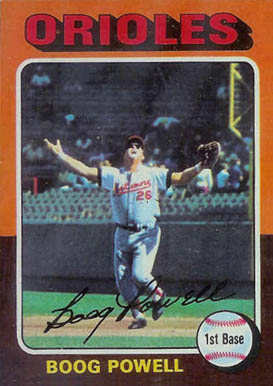
1975 Topps Traded Project: Boog Powell
Before he became a BBQ legend, Boog Powell was a mainstay of the great Baltimore Oriole teams of the 1960's and 1970's. Along with Hall of Famers Brooks and Frank Robinson, he was a significant and powerful part of 2 Orioles World Series winners. He was 4-time All-Star won the American League's Most Valuable Player award in 1970.
However, Oriole manager Earl Weaver's use of the platoon system started making his at-bats disappear. In 1973 Powell only got 103 starts at first and in 1974 it was down to 94. Prior to the start of the 1975 season, the aging slugger was traded to Cleveland with Don Hood for Dave Duncan and a minor leaguer. Reunited with former teammate turned player/manager Frank Robinson, Boog got the chance to play every day. He responded well, hitting .297 with 129 hits and 27 home runs (his highest marks since 1970), plus fielding his position at a .997 clip.
Topps only produced an Orioles version of his 1975 card.
However, Oriole manager Earl Weaver's use of the platoon system started making his at-bats disappear. In 1973 Powell only got 103 starts at first and in 1974 it was down to 94. Prior to the start of the 1975 season, the aging slugger was traded to Cleveland with Don Hood for Dave Duncan and a minor leaguer. Reunited with former teammate turned player/manager Frank Robinson, Boog got the chance to play every day. He responded well, hitting .297 with 129 hits and 27 home runs (his highest marks since 1970), plus fielding his position at a .997 clip.
Topps only produced an Orioles version of his 1975 card.
Saturday, October 15, 2011
Familiar Faces / Strange Places: Frank Robinson / Indians
On October 15, 1972, Jackie Robinson attended a World Series game that included a commemoration for the twenty-fifth anniversary of breaking the color line.
In his televised speech, Robinson again pushed baseball to employ blacks in more capacities: "I'd like to live to see a black manager, I'd like to live to see the day when there's a black man coaching at third base." When Robinson stepped onto the field, it was his second appearance at a Major League Baseball game since ending a self-imposed boycott of baseball which he had begun in protest of the sport's poor record in hiring minorities for managerial and front-office positions.
Nine days later, on October 24, 1972, Jackie Robinson died of a heart attack at his home in Stamford, Connecticut.
The first black baseball manager, Frank Robinson, was hired three years later by the Cleveland Indians.
In his televised speech, Robinson again pushed baseball to employ blacks in more capacities: "I'd like to live to see a black manager, I'd like to live to see the day when there's a black man coaching at third base." When Robinson stepped onto the field, it was his second appearance at a Major League Baseball game since ending a self-imposed boycott of baseball which he had begun in protest of the sport's poor record in hiring minorities for managerial and front-office positions.
Nine days later, on October 24, 1972, Jackie Robinson died of a heart attack at his home in Stamford, Connecticut.
The first black baseball manager, Frank Robinson, was hired three years later by the Cleveland Indians.
Labels:
Familiar Faces / Strange Places,
Indians
Tuesday, October 4, 2011
Parade of Ridiculousness: Blood clot red Bob Feller
This one was much easier to create because the original image was already in color. I've got a couple of others in the works, keep your suggestions coming in.
Monday, August 29, 2011
On this day.... Duane Kuiper goes deep
August 29th, 1977. After four seasons and 1,382 major league at-bats, Indian's second baseman Duane Kuiper hits a sinking line drive over the right field fence off Chicago starter Steve Stone for a first inning home run, helping Cleveland to a 9-2 win over the White Sox. Kuiper will come to bat 3,379 times in his 12 year career and finish with one career home run.
Thursday, February 17, 2011
Familiar Faces / Strange Places: Steve Carlton / Indians

Before there was Brett Favre, there was Lefty.
Steve Carlton was one of the best lefthanded pitchers in the history of baseball. His career is highlighted by 10 all star games, 2 (or 3?) world championships, 4 Cy Young awards, and entry into the Baseball Hall of Fame. Following two decades of brilliance in St. Louis and Philadelphia, it was clear to just about everyone but Carlton himself that he was out of gas. The Phillies released him and his 6+ ERA in June 1986. The Giants and White Sox gave him a shot later that summer and got below average results. Not willing to give up, Lefty signed with the Indians in the spring of 1987, pitched in 23 games (he started 14 times) before the Tribe traded him to Minnesota, where he went 1-5 for a team that won the World Series, without Carlton on the post-season roster. Since he was on the team, he got a World Series ring and a trip to the White House. Interestingly, when Carlton was photographed with his teammates at the White House, newspapers listed each member of the team with the notable exception of Carlton. Instead, Carlton was listed as an "unidentified Secret Service agent." The Twins brought him back in 1988 but he lasted only a month (0-1 16.76 ERA in four games) before the Twins released him, ending his MLB career.
Labels:
Familiar Faces / Strange Places,
Indians