Pages

Showing posts with label Expos. Show all posts

Sunday, July 8, 2012

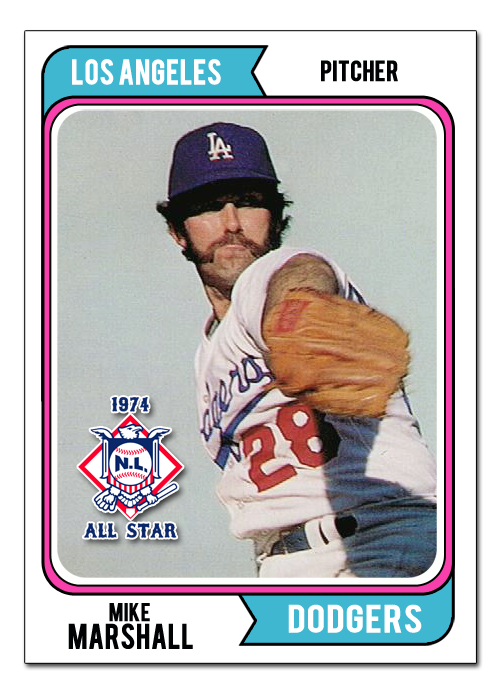
1974 All Star Project: NL Bullpen

Finishing the 1974 All Star Project with the National League pitching staff.
Ken Brett: George Brett's older brother played in the majors for 14 seasons, on 10 different teams. 1974 was the only All Star team he would make. A great hitter, his .310 batting average was higher than six of the eight starting position players on the Pirates in 1974, a team that won the National League Eastern division title.

Ken was credited with the win in this game, pitching scoreless 4th and 5th innings.
Buzz Capra: Like Ken Brett, 1974 was the only All Star game Buzz Capra would make. He was in the middle of best big league season, he would finish 16–8 with a NL leading 2.28 earned run average.

He did not pitch in the game.
Steve Carlton: A dominate ace, Lefty would be named to 10 All Star games and win 4 NL Cy Young Awards during his Hall of Fame career. In 1974 he led the NL with 240 strikeouts.

He did not pitch in the game.
Mike Marshall: The leading bullpen workhorse in the National League, Marshall made the All Star team in both 1974 and 1975. He led the league in appearances 4 times, including a record 106 games in in 1974. He was also named the Cy Young Award winner in 1974.

In this game, he pitched the final two innings without giving up a run.
Jon Matlack: This was the first of what would be 3 consecutive All Star appearances for the Mets lefthander. He would win the MVP of the 1975 game.

He pitched a scoreless sixth inning for the NL. 
Lynn McGlothen: Appearing on his only career All Star team, Lynn McGlothen would finish the season with a 16–12 record with an impressive 2.70 ERA.

He pitched a perfect 7th inning for the NL.
Steve Rogers: As the lone rep for the lowly Expos, this was the 1st of 5 career All Star appearances for Rogers. He would end the season with a league leading 22 losses. In 1982, he would start the the All Star Game for the NL.

He did not pitch in this game.

Interesting in seeing all the cards for this project? You can view them here.

Friday, March 2, 2012

DAHOF Top 100 -- #30 Andre Dawson

All you ever wanted to know about Andre Dawson is in his Hall of Fame speech from July 2010:

I didn't play this game with this goal in my mind, but I'm living proof that if you love this game, the game will love you back.

And I am proof that any young person who can hear my voice right now can be standing here, as I am. Like most of us up here, by the age of eight, I was using a busted broom handle for a bat and using rocks as a ball and by then I knew I was born to play this game. I dabbled in other sports, sure -- my knees are proof of that -- but baseball was my love. And baseball is where I belonged. And I found out quickly that if you love this game, the game will love you back.

It's still a great game, too. It bothers me when I hear people knock the game. There's nothing wrong with the game of baseball. Baseball will from time to time, and like anything else in life, fall victim to the mistakes that people make. It's not pleasant and it's not right. Those mistakes have hurt the game and taken a toll on all of us. Individuals have chosen the wrong road and have chosen that as their legacy. Others still have a chance to choose theirs. Do not be lured to the dark side. It's a stain on the game, a stain gradually being removed.

But that's the people, not the game. There's nothing wrong with the game. Never has been. I think people just forget why we ever got involved in the game in the first place. When we were nine and ten years old, we just loved playing the game. What we found was that if you put your heart into this game, if you love this game, the game will love you back.

That's why I made it here and anyone who can hear my voice right now can be standing here, as I am.

Look at me and these incredible men who make up the Hall of Fame. They are proof of that. There are many of us up here who had nothing, who came from nothing, who wondered if nothing was all there ever was. But look at us. There is hope. But you can't get here by skipping school or disrespecting your parents or your teachers or your coaches.

And you can't get here by dropping out of society. You can't get here if you believe you have nothing to lose out on the streets. You have everything to lose. But in this game you have everything to gain. A lot of kids feel abandoned, and I understand that. Some of us know what that feels like. It's a tough road and it's unfair. But feeling sorry for yourself isn't going to save you. Baseball can. Baseball can be your salvation. I am proof of that. And if you can hear my voice today, you can stand here, just as I am today.

As my grandmother used to say, "Take God with you. Get on your knees and believe it. Be thankful of the blessings before you receive them. If you can get left behind or you can get on board."

Love this game and the game will love you back.

Saturday, February 25, 2012

DAHOF Top 100 -- #37 Vladimir Guerrero

Spring Training has started and Vladimir Guerrero still does not have a team to play for in 2012. If he could still play in the outfield, I would absolutely love to see the Phils grab him... unfortunately he has not played regularly in the outfield since 2008. I gotta believe some AL team out there can use him... after 16 years in the big leagues, the man is less than 500 hits away from 3000.

From Tom Verducci in the May 2000 Sports Illustrated:

Think back to a time when baseball heroes came unadorned by batting gloves, wristbands, jewelry, tattoos, endorsements and ego. Go back to the days without televised games, when a box score and a picture in the morning paper left wide berth for imaginations to fill in the rest of the majesty of a player. Go back to when hitters were defined by how often they made solid contact with the baseball, not by how far they mashed it every once in a while between strings of strikeouts.

Go all the way back to last Friday. Go back to Vladimir Guerrero, the 24-year-old Montreal Expos rightfielder who seems as likely to have been discovered in amber as on the rural sandlots of the Dominican Republic. He plays baseball with a purity of purpose and talent rarely seen in a game that increasingly rivals the Academy Awards for overproduction.

Last Friday was a typical day in his small and simple world. His mother, Altagrasia, with whom he lives during the season in a downtown Montreal apartment (along with his brother and teammate, Wilton), cooked lunch for her sons and sent them off to play ball. At Olympic Stadium, Vladimir slipped into his Expos uniform and pulled on his stereo headphones, cranking merengue music to decibels that cause his teammates to worry about his auditory health. Then for nearly two hours he played a PlayStation baseball game—he always chooses to be the Expos, matched against various other teams—on a monitor in the middle of the clubhouse that has become his fiercely private preserve. Later, in the real game, he scorched three hits to knock in every Montreal run in a 5-1 win over the Milwaukee Brewers, with one hit going to left, one to center and one to right. Two of them were home runs. Finally, he drove back home with Altagrasia and Wilton.

The Guerreros do this for every Expos home game. Mom's cooking, the merengue, the video game, the hits and the family piling into the car for the ride home. O.K., not exactly the same every time. Sometimes Vladimir gets only two hits.


Read the rest of the article HERE

Saturday, December 3, 2011

DAHOF Top 100 -- #96 Al Oliver

Continuing the series of posts featuring my favorite top 100 ballplayers of all-time.

OK, I'll admit it... I have a soft spot in my heart for nomadic first basemen with the ability punish the baseball. Throw in a little bit of funky style, the quirky uniform number "0", a short stint with the Phillies, and a compelling hall of fame argument - you don't need much more of an explanation why I have included Al Oliver on my 'favorites' list.

Al began his career in Pittsburgh, playing alongside the great Roberto Clemente and Willie Stargell. He hit the last home run ever at Forbes Field AND had the first ever RBI at Three Rivers Stadium. He was part of the first "all black" starting lineup. He made seven all star games with three different teams, starting in the 1984 game as a member of the Montreal Expos. In Montreal he also won the 1982 NL batting crown. During his career, he won the Silver Slugger award at three different positions he left the game with a .303 career average.

My most vivid Al Oliver memories are from the four straight All Star Games (1980-84) he played in during his time with the Rangers and Expos. In each of these mid-summer classics he stylishly treated the national television audience, most of which had not seen him play all season, to a uncommon pair of new white cleats.

Thursday, November 10, 2011

The Matt Stairs Project

When Matt Stairs retired from baseball in August, I posted this in recognition of his contribution to the 2008 Phillies World Series win. As I was looking up his career stats for the post, I realized that he might have the longest display of uniform numbers of any player on BaseballReference.com. All told Stairs played for 12 different teams -- 13 if want to separate the Expos franchise he debuted for from the Nationals that he finished with. According to the fine folks a BR.com, Stairs wore 19 different uniform/number combinations during his career.


Former players Mike Morgan, Ron Villone, Deacon McGuire each played for 12 different teams. Morgan's uni/number combo count finished at 17, Villone got 14, and McGuire retired in 1912, several years before a major league team even issued uniform numbers. The only active player that is even close to Stairs is Miguel Cairo, his 2011 season with the Reds put him up to 14.

I thought it might be fun to create a set of Matt Stairs cards - showing him with every major league team he played for. Rather than drive myself crazy attempting to create new templates for each year, I decided to simply go with a 1968 Topps design. Matt Stairs was born in 1968.


1992 - 1993: Montreal Expos
Stairs makes his big league debut on May 29th, 1992 with the Expos in Cincinnatti. Appropriately he enters his first game as a pinch hitter.
1995: Boston Red Sox
After spending some time in Japan, Stairs is purchased by the Red Sox. He spends all of 1994 in the minors and returns to the big leagues in June. Hits his first ML Home Run off of the Royals Tom 'Flash' Gordon on July 5th, 1995. He gets one AB in the Red Sox 1995 ALDS loss to the Indians.
1996 - 2000: Oakland A's
Signs as a Free Agent with the A's following the 1995 season. It is in Oakland that Stairs establishes himself as a real live professional hitter. It is also the first place he finds regular playing time and he produces 122 HRs & 385 RBIs over his 5 seasons wearing the green and gold.
2001: Chicago Cubs
Following the A's bitter 2001 ALDS loss to the Yankees, Stairs is traded to the Chicago Cubs for a minor league pitcher named Eric Ireland. He spends one season on Chicago's North Side, delivering 85 hits in 128 games.
2002: Milwaukee Brewers
Once again a Free Agent, Matt signs with the Brewers for the 2002 season. Nothing spectacular happened for him while suffering through 106 losses playing for a last place team.
2003: Pittsburgh Pirates
Another season, another team. Now 35 years old, Matt signs with the Pirates as a Free Agent in December 2002. He had the best batting average of his career, hitting .292 in 128 games playing as a first baseman and outfielder. He also tops the 20 HR mark for the 5th time in his career.
2004 - 2006: Kansas City Royals
Matt continues his tour of the Major Leagues when he signs as a free agent with the Royals. He practically puts down roots and stays in KC for two and a half seasons. On June 2nd, 2005 -- against the Yankees he leads off the bottom of the sixth inning and sends a Carl Pavano pitch deep into the night for his 200th career HR.
2006: Texas Rangers
In July of the 2006 season, for the first time in his career, Matt Stairs joins a new team in the middle of the season. The Royals made a deadline deal with Texas, who had hoped Stairs could provide some veteran leadership on their young club. He just played in 26 games and hit only .210 before getting waived in September.
2006: Detroit Tigers
Claimed off the waiver wire by Detroit, Stairs joins his 3rd team of the 2006 season. The Tigers grabbed him in hopes he could help them hold their division lead. He appears in 14 games and the Tigers lost their division lead on the final day of the season, but still clinched the Wild Card. Since he was acquired after August 31st deadline, he was unable to play for the Tigers during the playoffs or World Series.
2007 - 2008: Toronto Blue Jays
After the 2006 season, the 39 year old Stairs once again found himself on the market as a free agent. In December he signed with the Blue Jays, returning to his native Canada. During the season and a half he spent in Toronto he found regular playing time, delivering 21 HRs in 2007 with an impressive .921 OPS. Following his strong 2007 season the Jays gave him a 2 year deal, but it didn't work out as he was released in August.
2008 - 2009: Philadelphia Phillies
Looking to add depth to their bench, the Phillies picked up the suddenly available Stairs in late August of 2008. He appeared in 16 games as the Phils won the NL East. Playing in his first playoffs since 2001, Stairs created a lasting memory with his first career postseason home run in Game 4 of the NLCS. His monster blast allowed the Phillies to take the lead over the Dodgers and win the game. That season he won the only World Series ring of his 16-year career. He returned in 2009 as a hero. On April 12th he hit a game-winning home run against the Rockies. It was the last home run called by Harry Kalas.
2010: San Diego Padres
In January, Stairs agreed to a minor league contract with the San Diego Padres with an invite to spring training hoping to crack their 25-man roster. He made the club out of spring training as a left-handed bat off the bench. On August 21st, Stairs hit his 21st career home run as a pinch hitter, breaking a tie with Cliff Johnson and setting a new Major League record.
2011: Washington Nationals
In December, Stairs signed a non-guaranteed minor league contract with the Washington Nationals. He made the club in spring training and went north with the team. Mostly used as a pinch-hitter, with four appearances at first base, in 65 at-bats he had 10 hits and two RBIs. He was designated for assignment on July 27, 2011 and released on August 1st. Two days later he announced his retirement.

Sunday, August 21, 2011

Cardinals at Expos - April 8th, 1970

This morning I re-discovered why I love the internet. By chance, I happened to find a great baseball gallery on a Flickr page provided by the Archives from the City of Montreal.

This galley contains 57 black and white images from the 1970 Expos home opener played at Jarry Park. It was the Expos second season of existence. Most of the images focus on the tiny ballpark (several of which you can see snow in the background) and the obviously cold Montreal fans. However, there are a few nice shots of recognizable players like Bob Gibson, Rusty Staub, and Dick Allen with Joe Torre standing on deck.

Of course I could not resist looking this game up on RETROSHEET and happily discovered that Dick Allen, playing in his first game as a member of the St. Louis Cardinals, collected three hits and drove in three runs. He also smacked the first HR of the season in the eighth inning off of Expos starter Bill Stoneman. The Cardinals won the game 7-2 with Bob Gibson collecting the win after throwing eight complete innings. Based on the image order it appears there is an image from Allen's first cardinal ab (he struck out to end the first inning) and the image I have posted above is from his second at bat (a double to lead off the fourth inning).

Friday, July 8, 2011

Dick Williams 1929-2011

Baseball lost one of it's all-time greats yesterday. Former player and Hall of Fame manager Dick Williams died in Las Vegas from an apparent brain aneurysm. He was 82 years old.

As a player, Dick Williams was good enough to play in over 1000 games in 13 seasons at the major league level. He made three pinch hitting appearances in the 1953 World Series as a member of the Brooklyn Dodgers. In 1964 he finished his playing career as a member of the Boston Red Sox with a .260 career batting average.

It was as a manager that he became a Hall of Famer. Immediately after retiring as a player, he spent three seasons managing in the Red Sox farm system. In 1967, prior to the start of the season Williams was named the new manager in Boston. The season before taking over the team finished ninth and the franchise had not won a pennant in 21 years. His first season he led the "Impossible Dream" Red Sox to the World Series, where they lost the Cardinals in seven games. Under his command, all-star Carl Yastrzemski was stripped of the title "Captain" because Williams didn't want anyone to question who was in charge. Refreshed and focused after having the heavy yolk of peer leadership removed, Yaz went on to win the last triple crown in baseball history.

In 1972 & 1973 he managed the Oakland A's to the first two of what would be three straight World Championships. These powerful and colorful A's teams included superstars like Reggie Jackson, Catfish Hunter, Rollie Fingers, Joe Rudi, Vida Blue, Ken Holtzman, Sal Bando and Bert Campaneris. He shocked his team and the baseball world after he announced he was quitting the Oakland dynasty immediately following the 1973 World Series. The reason: Williams had had enough of owner Charlie Finely and was angry at the embarrassing attempt to remove second baseman Mike Andrews from the roster with a phantom injury after Andrews had made a pair of errors earlier in the series. The A's went on to win a third straight ring under Alvin Dark in 1974.

George Steinbrenner actually named him as the manager of the 1973 Yankees, but it never happened. Feeling jilted after giving Williams his "best wishes", Charlie Finley filed a suit in federal court to prevent Williams from going to New York. His claim was Williams was still under contract with the Athletics. Finley apparently demanded two Yankee prospects in exchange. The Yankees balked and hired Bill Virdon instead. Finley eventually relented and Williams became manager of the Angels in the middle of the 1974 season and stayed in Anaheim for 3 seasons.

Dick Williams went on to manage the Montreal Expos, where he was unexpectedly fired in the middle of 1981 season. That '81 Expos team went on to deliver the only playoff appearance in franchise history. He also managed the San Diego Padres, where he led the Padres to the 1984 National League pennant and a trip to the World Series against the Detroit Tigers. He finished his managerial career with three seasons in Seattle. The 78 wins his 1987 Mariners delivered was the most in the first 14 seasons of the franchise. In 1993, George Steinbrenner was finally able to hire Dick Williams, this time an adviser and scout. He remained with the Yankees for 10 years and undoubtedly had a hand in building the Yankees teams that won three straight World Series titles from 1998-2000.

In his 21 years as a major league manager Williams finished with a .520 winning percentage, four pennants, and two World Series Championships. He is one of two managers in baseball history to lead three different teams to World Series appearances. Dick Williams was inducted into the National Baseball Hall of Fame by Veteran's Committee as Manager in 2008. His Hall of Fame plaque shows him wearing an A's cap.

In addition to being a great manager, it is my opinion that Dick Williams was blessed to wear some of the most interesting and memorable (and most colorful) uniforms in baseball history.

Sunday, February 20, 2011

Familiar Faces / Strange Places: Jose Canseco / Expos

Once considered the prototype of the modern day major league star, Jose Canseco burst upon the baseball scene as the American Rookie of the Year in 1986. Two years later (1988) he won the American League MVP and became the first player ever to record 40 home runs and 40 steals in one season. His Oakland Athletics team won three straight AL pennants and the 1989 World Series... but then it seemed wheels came off the tracks.

In August of 1992 he was traded to the Rangers. The next season he was allowed to pitch in a meaningless blow out loss to the Red Sox and injured his elbow, requiring Tommy John surgery. After a stop in Boston and a failed return trip to Oakland, he had a very productive season in 1998 with 46 HRs and 29 steals in Toronto. His accomplishments were lost in the HR derby media circus surrounding former teammate Mark McGwire and Sammy Sosa that season. He next went to Tampa (where he made an all star appearance) and the New York Yankees (Where he got a second ring). By 2001 he was basically done when he was cut by the Angels in spring training and ended up playing half of a season for the White Sox. The next spring he was wearing an Expos uniform, but failed to make the club when the season began.

His 462 career home runs rank him 32nd on the all-time list. Instead of being a baseball legend and hall of famer -- Canseco turned out to be the "canary in the coal mine" for the steroid era of major league baseball.

Sunday, February 13, 2011

Familiar Faces / Strange Places: Pete Rose / Expos

Thanks for all the nice comments about the new project. Please keep the ideas coming. There are so many choices. Also, if you have a clear picture of a suggested player, please feel free to send it over to me. The hardest part about this project is finding decent images to work with.


Here is another iconic baseball star in a strange uniform. Following the Phillies loss to the Orioles in the 1983 World Series Pete Rose was granted an unconditional release in late October 1983. Phillies management wanted to retain Rose for the 1984 season, but he refused to accept a more limited playing role. On January 20th, 1984 Rose signed a one-year contract with the Montreal Expos. His time in Montreal was highlighted on April 13, 1984, the 21st anniversary of his first career hit, Rose doubled off of the Phillies’ Jerry Koosman for his 4,000th career hit, joining Ty Cobb to become only the second player to enter the 4000 hit club. He played in 95 games before he was traded back the Reds to be a player/manager. Only his 1984 Topps Update and 1985 Donruss cards show Rose as an Expo.